
Picture this: you’re halfway through a Saturday squad session, ticking over laps before most people are even awake, when that familiar ache shows up in your shoulder again. By that evening you’ve Googled “shoulder pain swimming,” landed on a forum thread about torn rotator cuffs, and now you’re lying awake wondering if your swimming days are numbered.
Take a breath. It’s almost never quite like that — but it is worth taking seriously and getting properly assessed.
The old explanation for swimmer’s shoulder was; thousands of overhead strokes ‘pinch’ the rotator cuff against bone, the tendon gets irritated, and eventually it tears. It’s a tidy story, but it doesn’t match what we actually find when we look closely.
Tendon changes on scans are extremely common in swimmers’ shoulders — and just as common in swimmers with *no* pain at all. Weak rotator cuff strength doesn’t reliably predict who gets shoulder pain either.
What does seem to matter more is endurance — specifically, whether the muscles around the shoulder can keep doing their job properly through an entire set, not just for the first few strokes.
That’s good news, because it means a swimmer’s shoulder usually isn’t about damage that needs to be “fixed” — it’s about a shoulder that hasn’t been built to handle the load it’s currently under. And that’s something we can train.
When a swimmer comes in with shoulder pain, we’re not just checking whether it hurts when we poke it. A thorough swim specific assessment looks at:
– Training History — recent changes in volume, intensity, stroke count, or technique that might explain why symptoms showed up now
– Shoulder Muscle Strength and Endurance— how well those muscles hold up under repeated load, not just a one-off strength test
– Range of Motion Testing — through our shoulders and back in particular; which gets a lot of use when we swim!
– Technique-Specific Considerations— watching how the shoulder actually behaves in the water, not just on the treatment table; this might mean watching footage or speaking with your coaches!
This is exactly the kind of screening we run when we work directly with local swim clubs. If you coach a squad or train with one, we run regular mobility and strength screenings for teams — putting a whole group through these assessments before the heavy training block ramps up, so problems get picked up before they become time out of the water. Get in touch if you’d like to book one in for your squad.
Once we know what’s actually going on, the rehab program is built around that — not a generic “shoulder exercises for swimmers” sheet pulled off the internet. In practice, that usually means:
1. Endurance-based loading of the posterior shoulder and scapular stabilisers, progressed gradually over weeks rather than maxed out in one session
2. Programming that aims to keep you in the water, not pool side — we communicate with coaches so strength work complements pool volume instead of adding fatigue at the wrong time
3. Progressing based on how the shoulder responds not a fixed timeline — we reassess and adjust rather than handing over a 6-week program and hoping for the best
A note for our teenage swimmers
We see a lot of teenage swimmers moving into sub-elite squads, often right as training volumes step up and growth spurts are doing their own thing to joint mechanics and tissue capacity. That combination is exactly why early screening matters here — not because something is already wrong, but because it’s far easier to build good shoulder habits now than to fix bad ones later in the season. We work closely with coaches through these growth and training-load transitions so the strength work lines up with what’s happening in the pool.
When it’s worth getting checked
Most swimmer’s shoulder respond well to the right strength plan. It’s worth booking an assessment if you notice:
– Pain that doesn’t ease with rest from swimming
– A genuine loss of strength or range of motion, not just discomfort
– A sense that you are ‘losing feel’ of the water
– No improvement after 2–3 weeks of adjustments to training
Want a starting point?
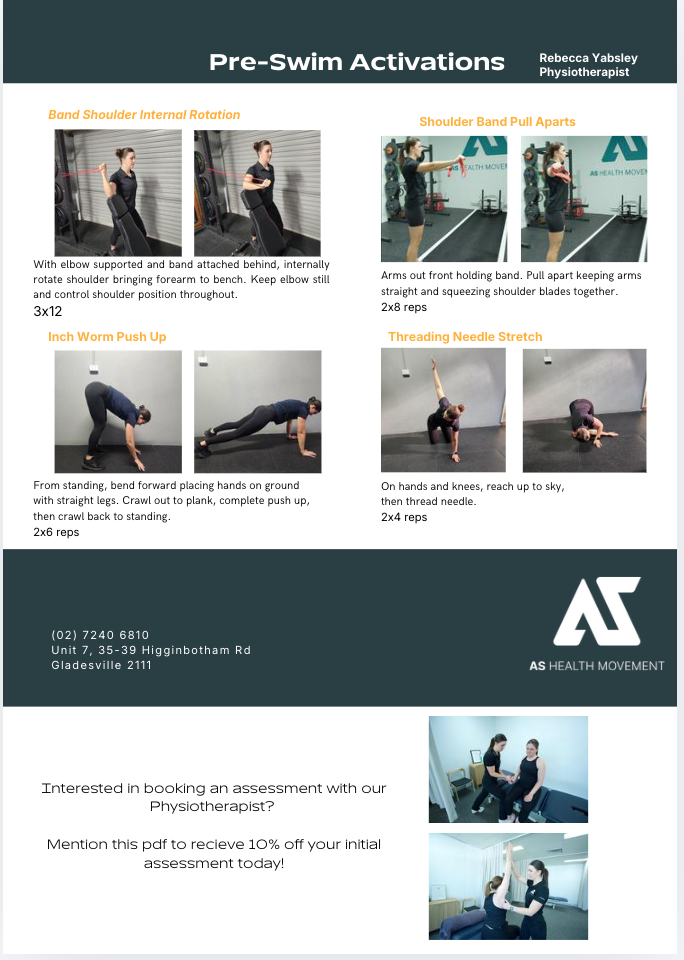
We’ve put together a free Pre-Swim Shoulder Warm-Up Routine — a few minutes of targeted activation for the muscles that matter most for swimmers, designed to go straight into your warm-up before you hit the water.
[Download the free warm-up routine insert link here] — or book an assessment with us if you want a proper look at what’s going on with your shoulder.
Please note: the information in this article is general in nature and is intended for people with little to no current shoulder pain. It is not a substitute for personalised medical advice. If you are experiencing pain or are unsure whether this information applies to you, please consult your own physiotherapist for an individualised assessment and management plan.
References
– Holt K, Delbridge A, Josey L, Dhupelia S, Livingston GC, Waddington G, Boettcher C. Subscapularis tendinopathy is highly prevalent in elite swimmers’ shoulders: an MRI study. *J Sci Med Sport*. 2022;25(9):720. doi:10.1016/j.jsams.2022.06.010
– Boettcher C, Halaki M, Holt K, Ginn KA. Is the normal shoulder rotation strength ratio altered in elite swimmers? *Med Sci Sports Exerc*. 2020;52(3):680–684. doi:10.1249/mss.0000000000002177 *(submitted/accepted 2019 — please confirm this is the paper you meant)*
– Salamh P, Bullock G, Chester R, et al. Risk Factors Associated with New Onset of Shoulder Pain and Injury Among the Athletic Population: A Systematic Review. *Int J Sports Phys Ther*. 2025;20(3):315–332. doi:10.26603/001c.129462
– Desmeules F, Roy J-S, Lafrance S, et al. Rotator Cuff Tendinopathy: Diagnosis, Nonsurgical Medical Care, and Rehabilitation – A Clinical Practice Guideline. *J Orthop Sports Phys Ther*. 2025;55(4):235–274. doi:10.2519/jospt.2025.13182

Be The First To Comment